The Alarm Architecture of a Person Who Has Given Up and Doesn't Know It Yet
The Alarm Architecture of a Person Who Has Given Up and Doesn't Know It Yet
Somewhere around 11 PM, you become a different person. A hopeful person. A person with ambitions and a morning routine and a genuine belief that tomorrow, finally, is the day everything changes. This person opens their phone and begins to build.
First alarm: 5:45. Ambitious, but possible. Second alarm: 5:50. A buffer. Responsible. Third alarm: 5:55. Just in case. Fourth alarm: 6:00. The real one. Fifth alarm: 6:05. The real real one. Sixth alarm: 6:10, labeled "SERIOUSLY GET UP."
You put your phone down. You feel prepared. You feel, genuinely, like someone who has their life together. You fall asleep.
You wake up at 8:04.
Meet the Two People Who Share Your Body
The person who sets the alarms — let's call them Night You — is an optimist of the highest order. Night You has plans. Night You is going to work out before work, make a real breakfast (not a granola bar eaten over the sink), journal for ten minutes, and arrive somewhere early for once in their adult life. Night You sets the 5:45 alarm with the quiet confidence of someone who has never, not once in recorded history, actually gotten up at 5:45.
Morning You is Night You's exhausted, betrayed successor. Morning You wakes up at the first alarm, performs a rapid cost-benefit analysis that takes approximately 0.3 seconds, and hits snooze with the practiced efficiency of a professional. Morning You does not care about the journal. Morning You does not care about the workout. Morning You has one goal, which is to extend the current situation by exactly nine minutes, then reassess.
Morning You will reassess six times.
The Snooze Button as Constitutional Right
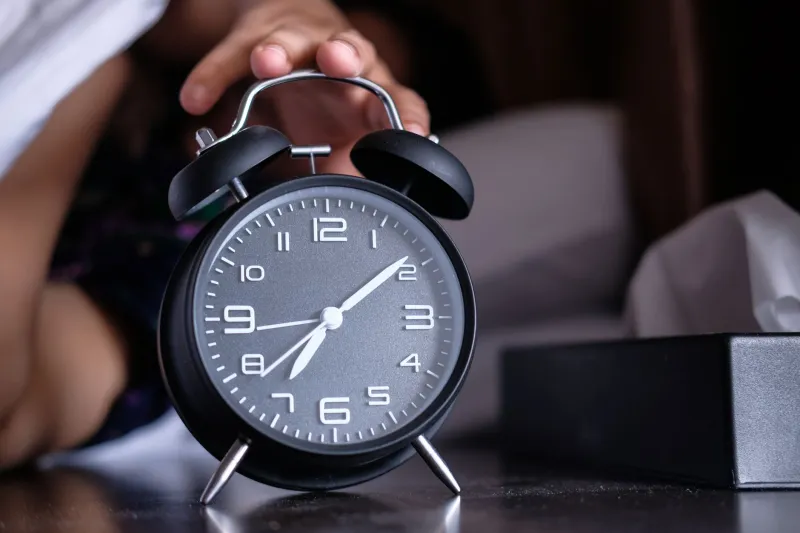
There is no other button in American life that gets pressed with more conviction than the snooze button. You hit it without looking. You hit it before you're fully conscious. Your hand finds it the way a compass finds north — instinctively, inevitably, without deliberation.
The snooze button is not a delay tactic. The snooze button is a negotiation. You are renegotiating the terms of your own morning in real time, from a horizontal position, with your eyes closed. You are saying: I acknowledge the alarm. I reject its premise. I will revisit this in nine minutes.
Nine minutes, by the way, is a genuinely strange amount of time to sleep. It is not restful. It is not enough for a dream. It is barely enough to forget that you were just awake. And yet. You will take it. You will take it every single time.
The Named Alarm Era
At some point — nobody remembers when — people started naming their alarms. This was supposed to help. The theory was that waking up to a label like "YOU CAN DO THIS" or "MORNING WORKOUT — DON'T QUIT" would provide enough motivational friction to counteract the gravitational pull of the mattress.
The theory was wrong.
What actually happens is that you dismiss an alarm labeled "THIS IS YOUR YEAR" with the same blank autopilot you'd use on an alarm labeled "alarm." The name doesn't matter. The message doesn't land. You are not in a state to receive motivational content at 6:03 in the morning. You are in a state to receive nine more minutes of unconsciousness, and that is all.
Some people have an alarm labeled "last one, I mean it." They have had this alarm for two years. It has never once been the last one.
The Mathematics of Being Eleven Minutes Late
Here is the strangest part of the whole system: it doesn't matter how many alarms you set. It doesn't matter whether the first one goes off at 5:30 or 7:00. The outcome is the same. You will arrive at your destination approximately eleven minutes after you were supposed to be there.
This is not a coincidence. This is physics.
The alarms create an illusion of buffer time that your brain spends entirely on snoozing. The first alarm was never real. The second alarm was never real. The real alarm is the one where you finally look at the time, do a calculation that involves subtraction and some light panic, and launch yourself out of bed in a single motion that would be impressive if it weren't already too late.
From that moment, everything happens at a speed that is technically possible but deeply undignified. You find clean clothes by a process that is more archaeological than intentional. You eat something standing up. You leave the house with your coffee, your keys, and the specific energy of someone who has accepted their fate.
The 5:30 Alarm: A Memorial
Let us take a moment for the 5:30 alarm. It was set with such hope. It represented a version of you that wakes up in the dark with purpose, laces up sneakers while the neighborhood is still quiet, and returns home glowing with the smug satisfaction of someone who got ahead of the day.
That person does not exist. That person has never existed. And yet you will set the 5:30 alarm again tonight, because Night You is an optimist, and optimists do not learn from Morning You's mistakes.
The 5:30 alarm will go off tomorrow. You will dismiss it before you're conscious. You will wake up at 8:04.
You will set it again tomorrow night.
The alarm labeled "FOR REAL THIS TIME" was dismissed at 6:47 AM. The author arrived at 9:11. No comment was made.