Sorry for Breathing: The American Art of Apologizing for Existing
The Morning Apology Marathon
You wake up and immediately apologize to your alarm clock for hitting snooze. Not out loud, obviously—you're not that far gone. But there's definitely a mental "sorry" as you slap that poor device into submission for the third time.
By the time you've stubbed your toe on the coffee table ("Sorry, table!"), apologized to your cat for stepping near its food bowl, and said "excuse me" to the bathroom mirror for making eye contact with yourself, you've already logged more apologies than a politician during election season.
And the day has barely started.
The Grocery Store Guilt Complex
The supermarket is where American apology culture reaches its peak performance. You apologize for:
- Existing in the cereal aisle when someone else wants to look at Cheerios
- Your cart being slightly to the left of perfect center
- Asking where the pasta sauce is located (even though that's literally what store employees are paid to help with)
- Taking more than 0.3 seconds to decide between chunky and smooth peanut butter
- The audacity of reaching for something on a shelf that another person might theoretically want to access sometime in the future
You find yourself apologizing to the self-checkout machine when it inevitably malfunctions, as if your very presence caused its existential crisis. "Sorry, I know you didn't expect heavy items in the bagging area, but here we are."
The Workplace Sorry-a-thon
Work is where apology addiction truly flourishes. You apologize for:
- Asking clarifying questions about unclear instructions
- Sending emails that are longer than a haiku
- Having opinions during meetings
- Your computer taking 0.2 seconds longer than usual to load
- Existing in the break room when someone else wanted to microwave fish
The crown jewel of workplace apologies? Saying sorry for being sick. "Sorry I can't come in today, I seem to have contracted a highly contagious virus through no fault of my own, and I'm apologizing for my immune system's poor performance."
You've probably apologized for apologizing too much. Meta-apologies are the advanced level of this particular American art form.
The Technology Guilt Trip
We've extended our apology reflex to our devices, treating them like temperamental roommates who might leave negative Yelp reviews about our cohabitation skills.
You apologize to your phone when you drop it, to your laptop when it freezes (clearly your fault for having too many Chrome tabs open), and to your car when it won't start (sorry for not psychically knowing you needed an oil change).
The GPS gets a particularly high volume of apologies. "Sorry, I know you said turn left, but I was in the right lane and there was traffic, and I'm sorry for questioning your judgment even though you once tried to route me through a lake."
The Social Situation Sorry Spiral
Social interactions are apology minefields. You apologize for:
- Not hearing someone the first time (even though they mumbled)
- Taking up space in a doorway
- Having a different opinion about whether pineapple belongs on pizza
- Your friend being late to dinner (somehow your responsibility)
- Weather you have zero control over
- The restaurant being busy (again, definitely your fault)
The worst part? Other people apologize right back, creating an infinite loop of unnecessary remorse. "Sorry I'm late!" "Sorry for making you wait!" "Sorry for apologizing!" "Sorry for making you apologize for apologizing!"
It's like a politeness ping-pong match where nobody wins and everybody feels inexplicably guilty.
The Existential Apology Crisis
By lunch, you've apologized approximately 40 times for things that were either:
a) Not your fault b) Not actually problems c) Basic human behaviors that require no apology
You start questioning whether you're sorry for existing in general. Are you taking up too much space on this planet? Should you apologize to gravity for requiring its services? Is breathing too loudly inconsiderate to other oxygen users?
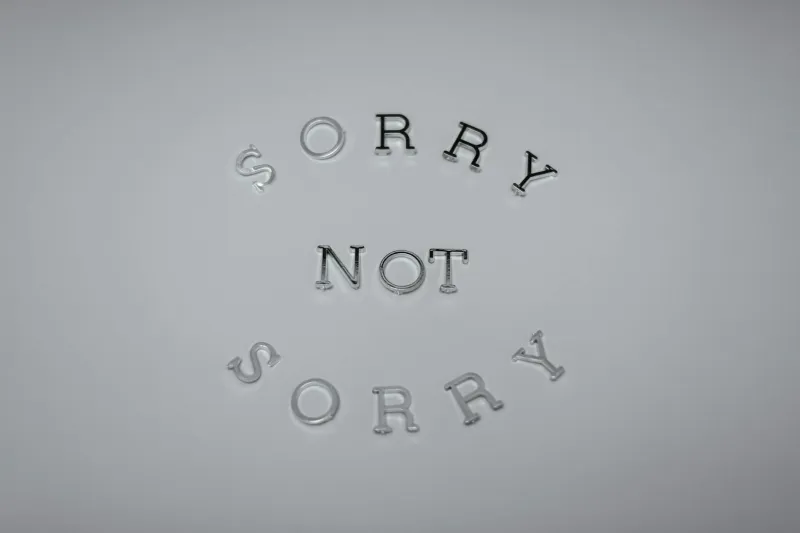
The Sorry-Not-Sorry Revelation
Here's the thing: most of these apologies aren't really apologies. They're social lubricant, verbal tics, and anxiety management strategies all rolled into one convenient package. We say "sorry" the way other cultures say "hello" or "bless you"—it's just something that fills conversational space and makes everyone feel slightly less awkward about being human.
Maybe we're not actually sorry for bumping into chairs or asking someone to repeat themselves. Maybe we're just sorry that existence is inherently awkward and we haven't figured out a better way to navigate it.
The Unapologetic Conclusion
So here's a radical thought: what if we stopped apologizing for taking up space in our own lives? What if we reserved "sorry" for actual mistakes instead of using it as a verbal security blanket?
But let's be real—you'll probably apologize for reading this article too slowly, and I'll probably apologize for suggesting you change a deeply ingrained cultural behavior.
Sorry not sorry, America. This is just who we are.
(Sorry for ending on a cliché.)