The Moment of Recognition
It happens in slow motion. You're walking toward a building at a perfectly reasonable pace, maybe checking your phone, maybe thinking about whether you remembered to turn off your coffee maker. Then you see them: a well-meaning human being approaching the same door from a different angle. They reach it first, which is fine—doors are not a competitive sport, despite what your anxiety might tell you.
But then comes the look. The over-the-shoulder glance. The eye contact. The smile. And suddenly, you're trapped in the most American of social contracts: the Long-Distance Door Hold.
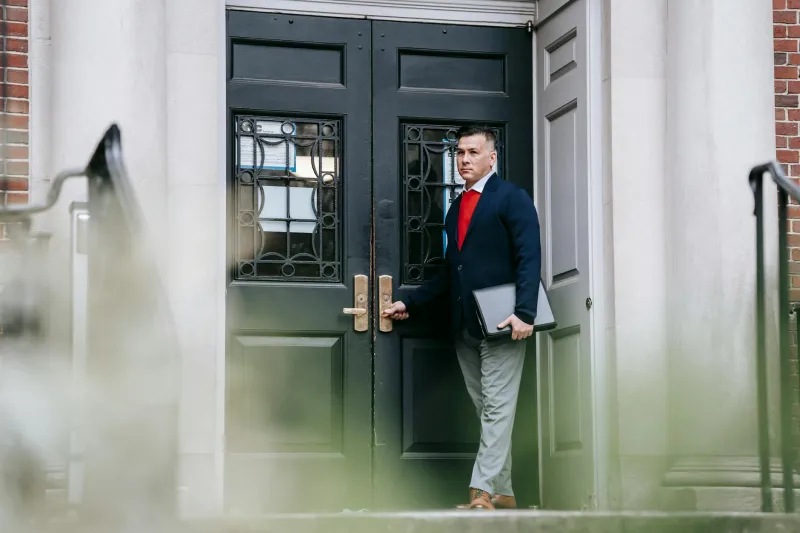
They're holding the door. You are approximately forty-seven feet away. The math is simple and terrifying.
The Physics of Forced Gratitude
What should be a simple transaction—person opens door, person walks through door—has suddenly become a physics problem involving velocity, social obligation, and the precise calculation of how fast you need to move to justify someone's continued existence as a human door prop.
The door-holder has committed to their position. They're in it now, standing there with that increasingly strained smile, one hand on the door, the other probably checking their watch. They've made their choice, and now you have to live with the consequences of their aggressive friendliness.
You have exactly 2.3 seconds to make a decision: Do you wave them off with a cheerful "I'm good, thanks!" and risk looking ungrateful? Do you break into an uncomfortable jog that will leave you breathless and sweaty for a simple door transaction? Or do you maintain your current pace and subject this poor soul to seventeen additional seconds of door-holding duty?
There is no good answer. This is America, where politeness goes to die.
The Acceleration Panic
You choose the jog. Of course you choose the jog. Because you're a decent human being who doesn't want to inconvenience someone who was just trying to be nice, even though their niceness has now created a situation that inconveniences everyone involved.
The transition from normal walking to grateful hustling is never graceful. You start with a slightly quickened pace, hoping they'll get the hint that you're "hurrying" without actually breaking into a run. But the door-holder maintains their position, their smile now frozen in place like a customer service representative who's been asked to explain cryptocurrency to someone's grandmother.
So you accelerate. What was once a dignified walk becomes a sort of speed-walking situation. Your arms pump slightly. Your breathing changes. You're now jogging toward a door like you're late for your own wedding, all because someone decided to be polite from an unreasonable distance.
The Gratitude Performance
As you approach the door, now slightly out of breath and definitely more disheveled than when this interaction began, you must perform the Gratitude Theater. This involves:
- A breathless "thank you" delivered with the enthusiasm of someone who has just been rescued from a burning building
- A smile that conveys both appreciation and mild exhaustion
- The subtle implication that this door-holding was exactly what you needed and not a social burden you've been carrying for the last thirty seconds
The door-holder, now relieved of their duties, responds with their own performance: "No problem!" they say, as if holding a door for an uncomfortably long time while watching a stranger jog toward them is a completely normal Tuesday afternoon activity.
Both parties know this interaction was weird. Both parties pretend it was perfectly normal. This is the American way.
The Distance Miscalculation Crisis
The real tragedy of aggressive door-holding is the complete failure of distance judgment that creates these situations in the first place. The door-holder sees you approaching and makes a split-second calculation: "This person will reach this door in approximately five seconds."
They are always wrong. Always.
What they perceive as "just a few steps away" is actually the distance of a small city block. What feels like "they're right behind me" is actually "they're in a different zip code." The human brain, which can calculate complex mathematical equations and remember seventeen different Netflix passwords, completely fails when it comes to estimating door-holding distances.
This leads to the most painful variation of the aggressive door hold: the Double-Take Door Hold. This is when the door-holder realizes their mistake halfway through the interaction, does a little "oh" face, and then commits even harder to their position because backing out now would be admitting they made an error in judgment.
The Ripple Effect
The worst part about the Long-Distance Door Hold is that it creates a domino effect of social awkwardness. Now you're both standing at the door together, having shared this mildly traumatic experience. Do you walk through the door first? Do you insist they go first? Do you both try to go through at the same time and create an even more awkward doorway dance?
Usually, you end up walking through the door while the original door-holder holds it open, which means they're now following you into the building. This creates the secondary social obligation of continued interaction. Do you thank them again? Do you make small talk? Do you pretend this whole thing never happened and immediately veer off in different directions?
The aggressive door-hold has transformed a simple building entry into a multi-stage social performance that neither party auditioned for.
The International Perspective
This phenomenon is uniquely American in its combination of good intentions and poor execution. We are a nation that prides itself on politeness but somehow manages to make politeness incredibly uncomfortable for everyone involved.
In other cultures, doors are functional objects. You open them, you walk through them, you close them. Simple. Efficient. No one is running anywhere. No one is performing gratitude theater. No one is holding doors for people who are still parallel parking.
But in America, we've turned door-holding into an extreme sport where the rules are unclear and everyone loses.
The Resolution
The only way to survive the Long-Distance Door Hold is to accept that it's going to be weird, lean into the weirdness, and remember that the door-holder is probably just as uncomfortable as you are. They didn't wake up this morning planning to trap a stranger in a politeness marathon. They were just trying to be nice.
So jog if you must. Say thank you with enthusiasm. Pretend this is normal. And maybe, just maybe, next time you're approaching a door and you see someone in the distance, consider the radical act of just... walking through the door yourself.
Your fellow Americans will thank you for it. Probably while jogging.